How to Love Yourself
Understanding self-love through self-knowledge


Self-love is often misunderstood as something to acquire or develop, but true self-love is discovered through self-knowledge.
To love yourself is to know yourself — because what you are, in truth, is love.
Lack of self-love arises from self-misperception. When we believe we are only a separate individual entity — a person with a name, form, and history — we experience ourselves partially. This partial knowing is what gives rise to insecurity, comparison, and fear.
True self-love is born when perception expands from being a person who is conscious to realizing I am consciousness itself, temporarily appearing as this person.
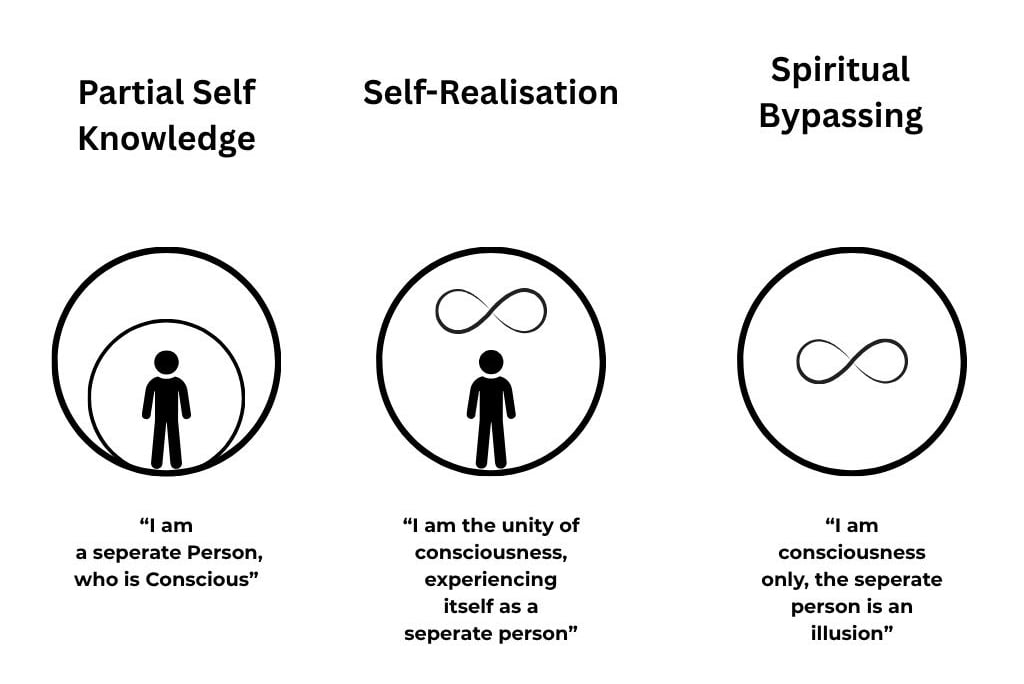
The diagram below illustrates this :
Partial Self-Knowledge — The person identifies as “a separate being who is conscious.” Here, love is conditional and limited because identity is confined to form.
Self-Realisation — Consciousness recognizes itself while still playing the part of a person. The individual is no longer separate from life but an expression of it.
Spiritual Bypassing — The person denies individuality altogether, clinging to the abstract idea of consciousness while rejecting human experience. This is not true self-realisation, but avoidance dressed as awakening.
Self-love emerges naturally in the middle stage — when you realize that you are both the wave and the ocean: a unique expression of the one consciousness that pervades all things.
To deepen this understanding, consider what Rupert Spira calls being knowingly the presence of awareness. You could think of it as the practice of being a wave remembering its water.
The wave doesn’t stop moving; it continues to rise, fall, and interact with other waves. Yet part of its attention rests in the quiet knowing that everything — itself included — is made of water. In the same way, self-love is not about perfecting the wave of your personality but remembering the substance of your being.
A branch can think of itself as just a branch, fragile and alone — or as an extension of the tree itself.
A dream figure can see itself only as a character within the dream — or as the activity of the dreamer’s mind.
Likewise, you can think of yourself as a separate person — a name, a story, a body — or as a divine expression of the One Infinite Creator.
To rest in your being is to go about your life — speaking, working, feeling — while quietly knowing that all of it arises within, and as, the one consciousness you are.
This remembrance transforms the ordinary rhythm of living into a meditation on love itself. When you know yourself as this water — consciousness — the idea of self-love no longer depends on effort or affirmation. Love is simply the recognition of what you are.
5 Practices for Self-Remembrance
The following practices are designed to gently restore awareness of what you truly are. They’re not about adding anything new to yourself, but about returning to clarity — remembering what has always been whole.
Ask for Clarity
Open your mind and heart to deeper understanding. A simple intention such as:
“May I perceive myself clearly and release all mistaken ideas of who I am,”
creates the openness for truth to reveal itself naturally.
See in Others What You Wish to Recognize in Yourself
Every encounter is a reflection. When you choose to see others as expressions of the same life that animates you, compassion and unity become your natural state. Every face, every tree, every moment mirrors the same consciousness you share.
Question Your Current Assumptions
Bring curiosity to the ideas you hold about yourself. Ask:
“What do I currently believe that I am, and is that truly what I am?”
“Who am I being in this moment?”
“From where is this thought or action arising — clarity or confusion?”
Inquiry loosens false identity and allows truth to surface effortlessly.
Affirm the Truth to Yourself
Thought directs awareness. Whenever emotion arises — especially when you feel triggered — use affirmations to realign the mind with what is true:
“I am One Self, united with Creation.”
“My heart knows the truth of oneness; beyond all appearances, there is only unity.”
“Without lack or division, I rest in the peace of perfect wholeness.”
Seeing From Awareness
When emotion, resistance, or discomfort arises, use it as a moment to return to the truth of what you are — the open, aware space in which all experience appears.
Rather than saying, “I am bored,” recognize, “Boredom is appearing in me, awareness.”
Rather than saying, “I am angry,” recognize, “Anger is appearing in the open space of awareness that I am.”
When resistance arises, remind yourself, “This isn’t me resisting — this is resistance appearing in me.”
This simple recognition shifts identity from the movement of mind to the stillness that knows it.
Awareness is never entangled in what it perceives; it remains untouched, silent, and free.
With practice, this way of seeing reveals that peace is not achieved by changing what arises, but by recognizing yourself as the changeless presence in which all arises and passes away.
Self-love is not achieved through striving or self-improvement — it unfolds through remembering.
To love yourself is to perceive yourself correctly: not as a separate individual trying to become whole, but as the wholeness of consciousness temporarily appearing as a person.
When you know yourself in this way, love ceases to be something you must find or practise, it reveals itself as what you have always been.